
How to Control Your Ego: Be honest, has this ever happened to you? That you prepared a presentation with a coworker. The boss praised you but gave your colleague a little too much credit. Then the question popped into your mind, “I did everything, so why did they get the credit?” Or has it ever happened that at home with your husband/
Or have you ever had a small argument with your spouse at home and you can’t accept that you might be wrong – small things that can slowly create a rift. Friends, these are the small things, but they can slowly create a rift. -They seem like small things, but they can slowly start to ruin relationships and your career. But it starts to make a difference, and there’s always a feeling of restlessness in your mind.
This is all a game of our ego.
We don’t consider ego an enemy, so it quietly ruins everything. That’s why today, we’re going to understand this ego in simple terms and learn what it is, how it’s ruining our lives, and most importantly, how to control it. If you also sometimes wonder, “Why do I get so defensive?” then this article is written especially for you. Let’s get started.
Read More: The Child Inside You Is Still Crying. Complete Truth About Inner Child Healing
What is Ego
Ego or Ahankara, is that voice within us that constantly says, “I am different from everyone else, I am the best, and what I say is right.”
In Sanskrit, it is called Ahamkara, meaning the process of creating the “I.” According to Hindu philosophy, the ego is born when we forget our true self and identify ourselves with our body, status, money, or opinions.
In psychology, Sigmund Freud described the ego as the mediator between the id (desires) and the superego (society’s rules). But nowadays, when we say “ego,” we mean that immature voice that compels us to see ourselves as better than others.
For example, a successful businessman believes his company runs solely on his hard work. He never gives credit to his team. As a result, the team leaves and the company comes to a standstill. This is ego, which blinds us.

The 7 Main Forms of Ego
Ego is not just arrogance; it lurks within us in many forms. Its seven forms are as follows:
- The Ego of Knowledge – “I know everything; what do you know?”
- The Ego of Wealth – Making others feel inferior by flaunting the power of money.
- The Ego of Position/Power – “I’m the boss; my way or the highway.”
- Beauty Ego – Looking down on others based on their appearance or body.
- Success Ego – Constantly flaunting your achievements and ignoring the hard work of others.
- Righteousness Ego – “I am a very good person; I have done so much.” This is the most hidden ego.
- The ego of sacrifice– “I have sacrificed everything for them.” This is also a form of ego.
Of these, the most dangerous is the ego of knowledge and sacrifice because you don’t see it in yourself.
Side Effect of Ego
When ego takes hold, it quietly erodes three of the most important areas of our lives:
- In relationships: Arguing over petty things, being unable to apologize, and the stubbornness of “I told you so.” As a result, love, friendship, and family fall apart.
- In your career; avoiding feedback, not giving credit to the team, and being afraid to learn new things. The result is that promotions stall, and people start calling you arrogant.
- In mental peace: constantly comparing yourself to others, fear of admitting mistakes, and worrying about “what people will think.” This leads to growing inner stress and emptiness.

How to Recognize the Ego?
The Ego is cunning. It hides behind the name of “self-esteem.” To recognize the Ego, look for these signs:
- You think you’re right in every argument.
- You feel jealous when others receive praise.
- You find it very difficult to admit mistakes or say “sorry.”
- You interrupt others.
- You constantly repeat your achievements.
- You become defensive as soon as you hear criticism.
- You think, “I did everything by myself.”
If you have 3 or more of these signs, it means your ego is a bit too active.
8 Practical Ways to Control Ego
Ego can’t be completely eliminated, but it can certainly be managed. Try these 8 methods starting today:
Develop self-awareness
Spend 10 minutes each day sitting in silence, observing your thoughts, and ask yourself, “What I’m feeling right now, is it ego or reality?”
Keep a gratitude journal
Every night, write down 3 things you’re immensely grateful for. Doing this shatters the “I did everything alone” mindset.
Let go of the illusion of being the doer
Always remember that you contribute to success, but you don’t get all the credit. Focus on effort, not results.
Practice empathy
Before any argument, take 10 seconds to think, “If I were in their shoes, how would I feel?”
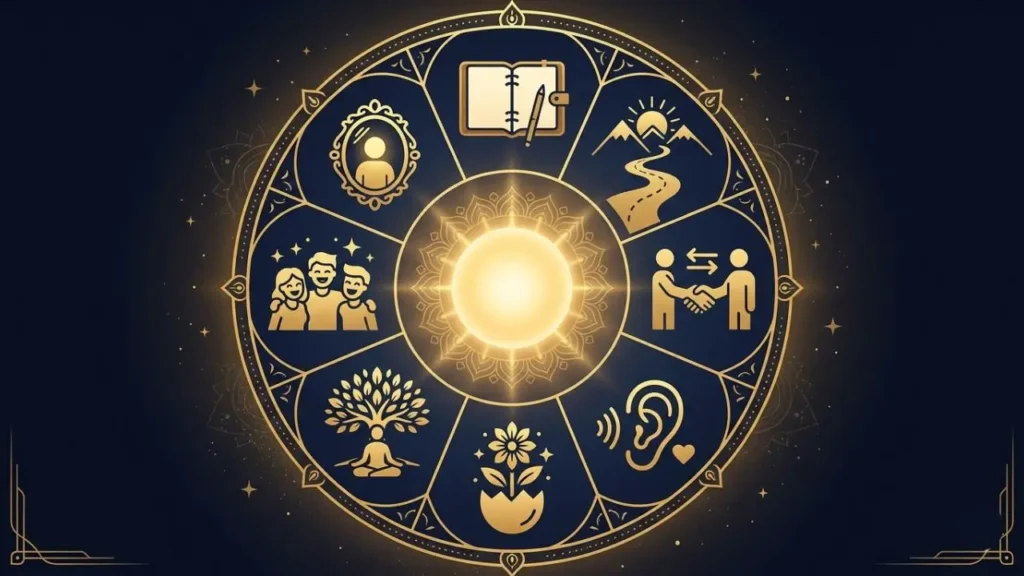
Learn to admit your mistakes.
To gain control, it’s essential to own up to your errors. The most powerful phrase for this is, “I was wrong, sorry.” Make it a habit to say it.
Treat criticism as a gift.
Consider every critique an opportunity for improvement. Your ego will take a hit, but you’ll grow.
Live in the present and get close to nature.
Once a week, go to a park or a hill. Sit there and feel how small you are in this vast world. Your ego will naturally calm down.
Keep true friends.
Befriend those who don’t inflate your ego but have the courage to tell you the truth.
Conclusion: How to Control Your Ego
Friends, the ego is not an enemy; it’s just an immature child living inside us. Learn to control it with love and understanding.
- Start a gratitude diary tonight.
- Tomorrow, for the first time, admit someone else’s mistake.
- Next week, sit in nature at least once.
When you control your ego, you’ll discover what true freedom is: no need to impress others or prove anything. Just peace and happiness.
Let me know in the comments which one of these 8 methods will you try today?
And if this article could help a friend or family member of yours who is struggling in their relationships because of ego, be sure to share it with them. Sometimes, one article can change a whole life.
FAQ: How to Control Your Ego
What does ego mean?
Ego means “arrogance” or “the sense of self.” It is the inner thought that makes us feel we are different or better than others. When it is balanced, it becomes self-esteem, but when it grows, it harms relationships and mental peace.
What are the types of ego?
There are mainly two types of ego – Healthy Ego and Unhealthy Ego. A healthy ego gives us confidence and self-respect, while an unhealthy ego makes us arrogant, defensive, and separate from others. A healthy ego is essential for balance in life.
What are the 7 types of ego?
Ego can take many forms, but there are generally considered to be 7 types: The ego of knowledge (I know everything), the ego of wealth, the ego of power/status, the ego of beauty, the ego of success, the ego of religion/goodness, the ego of sacrifice or humility (I am the best). All these forms gradually distance a person from reality.
What are Freud’s 3 principles?
According to psychologist Sigmund Freud, the human personality is divided into three parts: the Id, the Ego, and the Superego. The Id is the source of our desires and emotions, the Ego makes decisions based on reality, and the Superego represents morality and societal rules. The Ego works to create a balance between these two.
What is the Ego in psychology?
In psychology, the ego is the part of a person that thinks and makes decisions based on the real world. It balances our desires (id) and morality (superego). But when it becomes unbalanced, a person becomes overly defensive, caught up in comparisons, and mentally stressed.

3 thoughts on “Is Your Ego Silently Destroying Your Life? 8 Powerful Ways to Control It”