
How to Practice Mindfulness: Picture this, You wake up and before your eyes fully open, your thumb is already scrolling. Emails, news, someone’s highlight reel on Instagram. By the time you reach the kitchen, your mind has already visited three different countries of worry: yesterday’s mistake, today’s deadline, tomorrow’s uncertainty.
You pour your coffee. You don’t taste it. Sound familiar?
This is the default setting of modern life. We are physically present but mentally somewhere else always. And the cost? Chronic stress, shallow relationships, a gnawing feeling that life is passing you by even as you live it.
Mindfulness doesn’t ask you to escape your life. It asks you to actually show up for it.
No apps required. No retreat in the Himalayas. No hour-long meditation sessions. Just a simple, science-backed shift in how you pay attention and it can change everything from your stress levels to your sleep to the way you listen to the people you love.
In this article, you’ll learn exactly what mindfulness is, why your brain desperately needs it right now, and how to weave it into your real, busy, messy daily life starting today.
Read More: Is Your Ego Silently Destroying Your Life? 8 Powerful Ways to Control It
What is Mindfulness
Mindfulness means being fully present in the current moment, without any judgment. That is, simply observing, feeling, and accepting what is happening. Neither trying to change it, nor running away from it.
This is not a new discovery. This concept, which comes from a thousands of years old Buddhist tradition, has now been scientifically validated all over the world.
Mindfulness meditation is an activity, but mindfulness itself is a method, a mental state. Just as you go to the gym to build muscles, mindfulness makes your mind stronger and calmer.
The simple meaning of Mindfulness (for everyone)
In simple terms:
- When you’re drinking tea, you’re just drinking tea, no worrying about tomorrow, no planning for tomorrow.
- When you’re talking to a child, your full attention is on what they’re saying.
- When you’re working, you’re completely immersed in that task.
It’s about getting off autopilot and living life consciously. You might be thinking, “This is difficult. My mind wanders all the time.”
Don’t worry. This is the most common experience. Every beginner feels this way. But with a little practice, it becomes a habit.

Why is Mindfulness Important in Today’s World?
Today we are drowning in a sea of information, yet we feel a lack of happiness and contentment.
We multitask, but we can’t seem to finish anything. The result is constant stress, anxiety, irritability, and burnout.
Mindfulness reconnects us with ourselves. It teaches us that happiness isn’t in something external, but in fully experiencing this moment.
What Actually Happens in Your Brain When You Practice Mindfulness
Most people think mindfulness is about emptying your mind. That’s the biggest myth that stops beginners before they even start.
Here’s What’s Really Happening and Neuroscience is Fascinating
Your brain has a default network called the Default Mode Network (DMN). Neuroscientists call it the “wandering mind network.” When you’re not focused on a task, this network fires up automatically replaying past regrets, rehearsing future anxieties, running an endless loop of mental chatter.
Studies from Harvard Medical School found that humans spend nearly 47% of their waking hours thinking about something other than what they’re actually doing. And that mind-wandering, the research found, is directly linked to unhappiness, regardless of what people are thinking about.
Mindfulness works by training your brain to notice when the DMN has hijacked your attention and gently redirect it back to the present.
Over time, regular practice creates measurable physical changes:
- The prefrontal cortex (responsible for focus and decision-making) becomes thicker
- The amygdala (your brain’s alarm system for stress and fear) shrinks in reactivity
- The hippocampus (memory and emotional regulation) shows increased grey matter density
A landmark study by Dr. Sara Lazar at Harvard showed these structural brain changes in people who meditated regularly proving that mindfulness isn’t just a feeling. It’s a training program for your brain.
And the best part? Research suggests meaningful changes begin in as little as 8 weeks of consistent practice.
You’re not trying to silence your mind. You’re teaching it a new skill: the ability to choose where your attention goes, instead of being dragged wherever it wanders.
How to Apply Mindfulness in Daily Life
The best part is that you don’t need to set aside separate time for it. You can incorporate it into your existing daily routine.
Start your morning mindfully
Don’t pick up your phone as soon as you get out of bed. For 3-4 minutes, just close your eyes and focus on your breath. Feel the breath coming in and going out. This small practice sets the tone for the entire day.
Mindful Eating at Mealtime
Most people eat while looking at their phone, TV, or YouTube. Try it once and eat with your phone put away. Fully experience the color, aroma, texture, and taste of the food. Chew each bite slowly.
You’ll be surprised at how delicious it tastes.
While working or studying
Take a 1-minute break every 45-50 minutes. Sit up straight, close your eyes, and just observe your breath. This little reset button will multiply your productivity.
While using your phone and social media
As you scroll, ask yourself: How am I feeling right now? Often we scroll out of boredom, loneliness, or FOMO.
When you become aware, you’ll naturally spend less time on it.
Walking Mindfulness
When you go for a walk in the morning or evening, don’t take your phone with you. Pay attention to the feeling of your feet touching the ground. Feel the breeze on your face. Listen to the sounds of the birds. This becomes a simple walking mindfulness meditation.
Mindful Breathing (the easiest technique)
Can be done anywhere, anytime:
- 4 seconds in
- 4 seconds hold
- 4 seconds out
- 4 seconds hold (Box Breathing)
It instantly calms you during times of stress.

Easy Mindfulness Techniques for Beginners
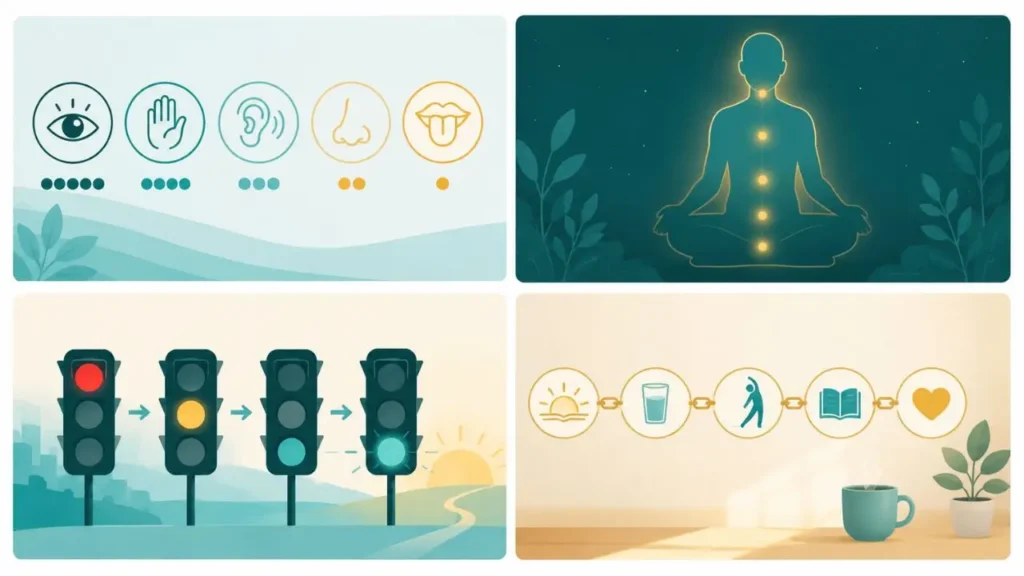
5-4-3-2-1 Grounding Technique
- 5 things to see
- 4 things to touch
- 3 sounds to hear
- 2 scents to smell
- 1 taste to taste.
Body Scan
Over 3–5 minutes, bring your attention to each part of your body from head to toe. Consciously relax any areas of tension.
STOP Technique
S – Stop
T – Take a breath
O – Observe (what you’re feeling)
P – Proceed mindfully
Habit Stacking
Make these small habits mindful when brushing your teeth, making coffee, or riding in the elevator.
Common Mistakes While Practicing Mindfulness (Avoid these)
- Expecting perfection
- Blaming yourself when your mind wanders
- Starting with a long-term goal (begin with 2-5 minutes)
- Thinking it’s just “relaxation”—this is training, not rest
Remember: It’s natural for the mind to wander. Don’t judge it; just gently bring it back. That’s the practice.
Conclusion: How to Practice Mindfulness
Mindfulness is not a way to escape from life. It is a way to live life more deeply, with clarity, and with love.
Challenges will come in your life. But mindfulness will give you a small island of peace even in the midst of those challenges.
This evening, just close your eyes for 5 minutes and focus on your breath. Just do that. The rest of the journey will begin on its own.
Now it’s your turn. Tell us in the comments: what one small mindfulness habit are you going to start today?
Your one small step can make your entire life more beautiful and peaceful. Start. Now. From this very moment.
FAQ: How to Practice Mindfulness
What does mindfulness mean?
Mindfulness means living in the present moment with full awareness. It means experiencing what is happening right now without judgment. In this, you consciously pay attention to your thoughts, feelings, and surroundings, instead of living on autopilot.
How do I practice mindfulness?
You can start with very small steps. Sit quietly for 2-5 minutes each day and just focus on your breath. Also perform daily activities like eating, walking, or drinking tea with full awareness. Gradually, your mind learns to stay in the present.
Is Mindfulness different from Mindfulness Meditation?
Yes, the two are related but not the same. Mindfulness is a mental state in which you are aware of the present moment, while Mindfulness Meditation is the practice of developing that state. Meditation is a technique, and mindfulness can be its result.
Why doesn’t mindfulness work for me?
Often, people expect perfection right from the start. It’s completely normal for the mind to wander. Mindfulness isn’t about completely emptying your mind, but about gently bringing your attention back when it wanders. With regular practice and patience, its effects start to be felt gradually.
What is the best technique for beginners?
For beginners, Mindful Breathing is considered the easiest and most effective technique. In this, you simply focus on your breath as it enters and leaves. Additionally, the 5-4-3-2-1 Grounding Technique and Walking Mindfulness are also very simple and helpful practices for beginners.

1 thought on “What Is Mindfulness? Simple Ways to Practice It Daily”