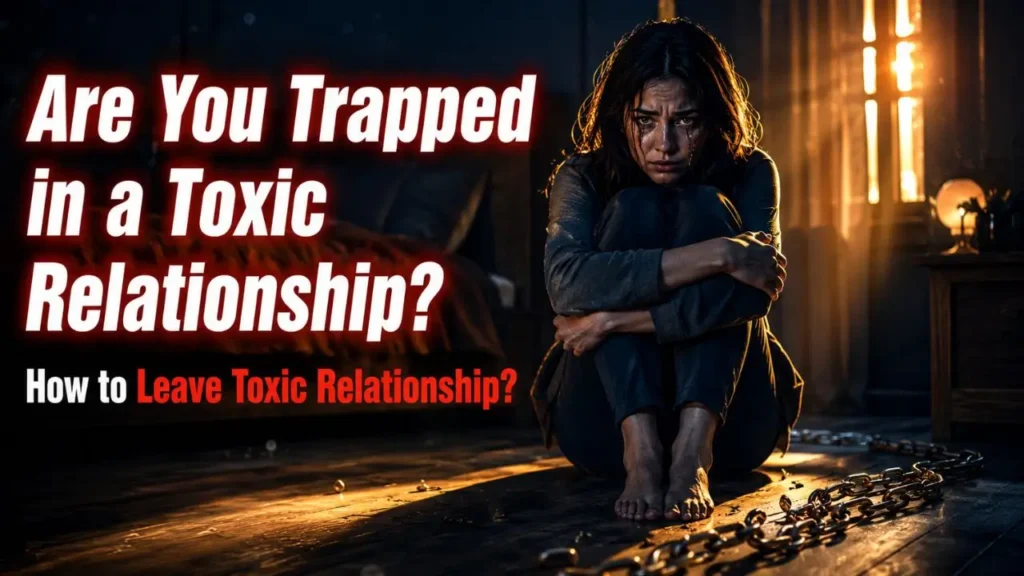
How to Leave Toxic Relationship: You don’t realize it at first. The relationship starts beautifully with constant attention, deep conversations, feeling finally seen. But somewhere along the way something shifts. You start walking on eggshells. You apologize for things that are not your fault. You shrink yourself to keep the peace.
The most dangerous thing about a toxic relationship is not the fighting. It is the silence, the slow erosion of who you are, so gradual you barely notice until one day you look in the mirror and don’t recognize yourself anymore.
Research shows that emotional abuse can be just as damaging as physical abuse, yet it often goes unrecognized for years, even by the person experiencing it.
This article is not just about identifying red flags. It is about understanding why these relationships feel so impossible to leave, how manipulation rewires your thinking and most importantly, how to find your way back to yourself. You deserve more than surviving. You deserve to thrive.
Read More: You’re Not a Fraud ! Here’s How to Finally Beat Imposter Syndrome
What is a Toxic Relationship
A toxic relationship is one in which one or both partners harm each other’s emotional, mental, or even physical health. Here, control takes the place of love, criticism takes the place of respect, and fear takes the place of security.
In a healthy relationship, both partners help each other grow. But with a toxic partner, you constantly feel diminished. Your happiness becomes dependent on their whims. Your opinions, your needs, and your boundaries are all ignored.
The truth is that most toxic relationships seem very attractive at first. There’s love bombing, so much love that you think, “This is perfect for me.” But gradually the real face begins to show.

Hidden Signs of a Toxic Relationship
The symptoms of a toxic relationship do not always scream at you. They quietly chip away at your self-esteem.
- Constant Criticism disguised as care: “I’m only saying this for your own good,” followed by jabs at every little thing.
- Isolation from support system: Slowly pushing you away from friends and family by saying, “They don’t understand you.”
- Unpredictable mood swings: One day a lot of love, the next ice-cold—this cycle always keeps you on edge.
- Financial control: Inappropriate control over your income or spending.
- Guilt-tripping: Blaming you for every mistake (which is often their own).

How Emotional Manipulation and Gaslighting Slowly Destroy You
Emotional manipulation is often subtle, hiding behind love, concern, or humor rather than showing itself openly.
A manipulative partner doesn’t control you with force. They control you with confusion. They alternate between warmth and coldness, keeping you constantly anxious, constantly trying to earn back the version of them that first made you fall in love. Psychologists call this intermittent reinforcement and it creates a psychological attachment stronger than consistent love ever could.
Then comes gaslighting, perhaps the most insidious form of emotional abuse. It sounds like:
- That never happened, you are imagining things.
- You are way too sensitive.
- Everyone agrees with me, not you.
Over time, you stop trusting your own memory. Your own instincts. Your own reality. You begin to think that you are the real problem.
This is by design. Studies link prolonged gaslighting to anxiety disorders, complex PTSD and chronic self doubt that persists long after the relationship ends.
The first step toward healing is not leaving it is trusting yourself again. When something feels wrong, it usually is. Your feelings are not flaws. They are signals. And they deserve to be heard.

Constant criticism, controlling behavior, and relationship red flags
A toxic partner often shows these red flags:
- Questioning every decision you make.
- Downplaying your successes
- Making unwanted comments about your body, clothes, or weight
- Humiliating you in front of friends and then saying “it was a joke”
- Dredging up past mistakes in every argument
Red flags that people often ignore:
- “They’re just possessive because they love me” – this justification is very dangerous.
- “They’ll change after marriage” – this hope usually falls apart.
Impact of a Toxic Relationship on Mental Health
Spending a long time in a toxic relationship can have serious and lasting effects on a person’s overall health and happiness. Here are some:
- Persistent low self-esteem
- Anxiety and panic attacks
- Depression
- Sleep disorders
- Identity crisis (losing yourself)
- Physical symptoms like chronic fatigue, headaches, weak immunity
You start to feel like a “shell of a person.” That sparkle, that enthusiasm, those dreams, they all become blurred.
Why can’t people leave toxic relationships?
This is the most important question.
- Trauma bonding: The cycle of abuse and love triggers dopamine effects like an addiction.
- Fear of being alone: “Better to stay than be alone”- this thinking is very common.
- Sunk cost fallacy: “I’ve already spent so much time on this. Walking away now feels impossible.”
- Childhood conditioning: If your parents’ relationship at home was toxic, this pattern feels normal.
- Financial dependence or social pressure: Especially in Indian society, the fear of “what will people say.”
Sometimes the hardest battle is internal, with that voice inside you that says, “You should put up with it.”
Can a toxic relationship be repaired?
This is a question almost everyone asks who is in a difficult relationship. The truth is that not every toxic relationship is the same. Some relationships can be repaired, if:
- Both partners genuinely want to change
- The partner acknowledges the toxic behavior
- Both are ready for couples therapy
- There is no pattern of physical abuse or repeated emotional abuse
But repair is not possible when:
- The partner refuses to admit their mistakes
- Gaslighting and manipulation happen repeatedly
- Your physical safety is at risk
- The behavior doesn’t change even after an apology
Forgiving and staying in the relationship are two different things. You can forgive someone and still walk away. Forgiveness is for you, not for them.
Practical Steps to Get Out of a Toxic Relationship
Now let’s go through the step-by-step roadmap to exit a toxic relationship:
1. Acknowledgment
First, acknowledge that the relationship is toxic. Write in a journal. Write down facts, not emotions.
2. Safety First
If you are subjected to verbal, emotional, or physical mistreatment, take steps to protect yourself and connect with trusted people or professional support services for guidance.
3. No Contact or Limited Contact
Minimize contact as much as possible. Blocking may be necessary.
4. Build a Support System
Include a therapist, close friends, and family you trust as your support system.
5. Set Boundaries
Set boundaries, say “no” when needed, and prioritize your own well-being.
6. Seek Professional Help
Therapy (CBT, EMDR, trauma-informed therapy) can be very helpful.

How to start self-respect and emotional healing?
Healing doesn’t happen overnight. It’s a daily choice.
- Daily affirmation: “Love flows naturally into my life, and I never have to sacrifice my peace or dignity to receive it.”
- Reconnect with yourself: Pick back up those old hobbies you had let go of.
- Body healing: Regulate your nervous system with exercise, good food, and sleep.
- Feel your grief: Let all emotions- sadness, anger, relief come through.
Remember: Healing isn’t linear. Some days you’ll feel fine; other days old memories will hurt. That’s normal.
Recovery Tips After a Breakup
- Strictly follow the no-contact rule.
- Take a social media detox.
- Create new routines.
- Keep a gratitude journal.
- Slowly start dating when you feel emotionally ready.
- Celebrate your growth. Every small victory.
What is a healthy relationship?
In a healthy relationship:
- Mutual respect
- A safe space to express feelings
- Encouragement for individual growth
- Healthy conflict resolution
- Emotional safety
- Equality
A healthy partner doesn’t highlight your mistakes, but rather tries to correct them with you. They are happy for your success, not jealous.
Asking for help is a sign of strength.
If you’re ready to talk to someone, these Indian helplines can help you;
Helpline | Number | Available |
iCall (Tata Institute) | 9152987821 | Mon–Sat, 8am–10pm |
Vandrevala Foundation | 1860-2662-345 | 24×7 |
Snehi (Emotional Support) | 044-24640050 | Daily, 8am–10pm |
iHeal (Abuse Support) | 8882-396-396 | Mon–Sat |
Remember: these calls are confidential. You don’t have to fight this battle alone.
Conclusion: How to Leave Toxic Relationship
Leaving a toxic relationship isn’t easy, but it can be the strongest decision of your life. When you leave, it will hurt a lot at first. But beyond that pain, you will find the version of yourself you’ve always wanted to be confident, peaceful and self loving.
You are not alone. You are not weak. And most importantly, you are worth more than this relationship.
If today you take even a small step—like talking to a therapist, telling a trusted friend the truth, or simply promising yourself, “Enough is enough”—that is the beginning of your new life.
Your healing has begun. Just keep moving forward.
FAQ: How to Leave Toxic Relationship
What is a toxic relationship?
A toxic relationship is one where love, respect, and support are replaced by an atmosphere of control, criticism, emotional abuse, or fear. In such a relationship, a person gradually begins to lose their happiness, self-confidence, and peace of mind.
How do I know if I’m in a toxic relationship?
If your partner constantly puts you down, ignores your feelings, tries to isolate you from friends and family, or makes you feel guilty for everything, these could be signs of a toxic relationship. In such a relationship, you often feel tired, stressed, and insecure.
How to end a toxic relationship?
To end a toxic relationship, it’s first necessary to accept that the relationship is harmful to you. After that, get help from trusted friends, family, or a therapist, set clear boundaries, and cut off contact completely if needed. Prioritizing your safety and mental health is the most important thing.
When should you leave a toxic relationship?
You should seriously consider leaving when the relationship consistently harms your self-esteem, mental health, or physical safety, and all attempts at improvement fail. If the relationship involves emotional, mental, or physical abuse, it’s best to get out safely as soon as possible.
Why do people stay in toxic relationships?
Psychologically, many people stay in toxic relationships due to trauma bonding, fear of loneliness, low self-esteem, emotional dependency, or social pressure. People often stay in unhealthy relationships because they believe their partner will eventually change, even when nothing improves over time.

1 thought on “How to Leave a Toxic Relationship & Heal Yourself”