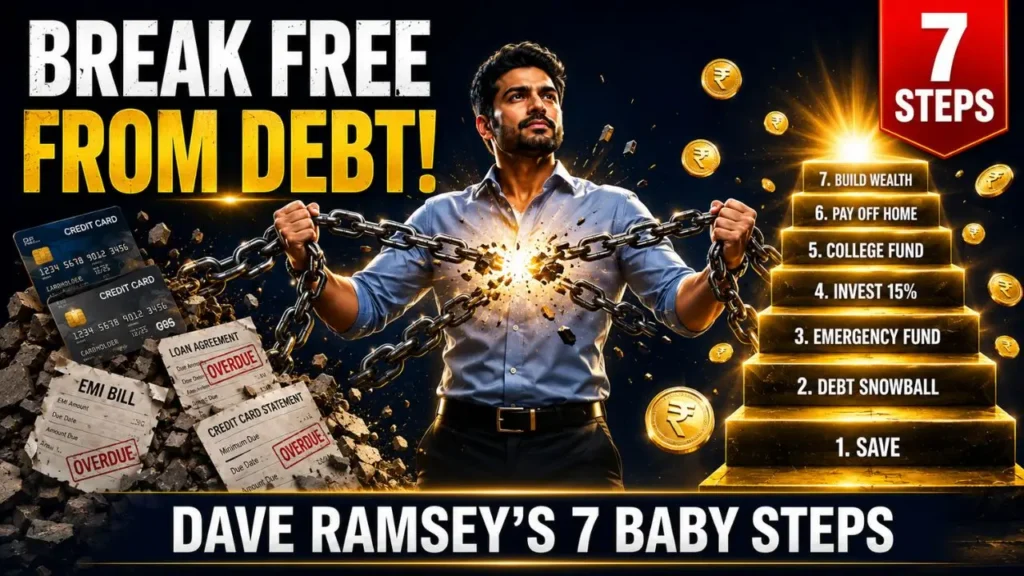
Dave Ramsey Baby Steps: Does your salary vanish into EMIs, credit card bills, and old loans before the month even ends? Does it feel like the debt cycle will never break?
You are not alone. Millions of Indians live under this financial pressure every single month.
The good news? Dave Ramsey’s Baby Steps Formula has already helped millions of people worldwide become completely debt free and it can work for you too.
This is not a get-rich-quick trick. It is a simple, practical, behavior-based system that builds lasting financial habits.
Today, we break down all 7 Baby Steps in plain English with India-specific examples so you can start your Debt Free journey right now.
Read More: Money Vibration Connection: Raise Your Vibration, Attract Wealth
Who is Dave Ramsey?
Dave Ramsey is America’s most popular personal finance guru. He himself took on millions of dollars in debt 20-30 years ago and went bankrupt. From that difficult experience, he learned that debt is not just a financial problem, but also a mental and relationship problem.
Today, he shows millions of people the path to becoming debt-free through his radio shows, books (most famously Total Money Makeover), and online courses. His philosophy is that financial success is 20% math and 80% behavior. If you can control yourself, everything else is possible.,
What are Dave Ramsey’s Baby Steps?
Baby Steps are seven small steps that take you out of debt and toward financial freedom. This system is popular because it builds lasting habits, not quick results.
Ramsey says that debt is not a tool, but a trap. His formula gives you an emergency fund first, then eliminates debt, and finally leads you toward building assets.

Baby Step 1 – Create a Starter Emergency Fund
The very first step is to create an emergency fund of ₹50,000 to ₹100,000 (or about 3–6 months’ worth of small expenses).
Objective: To avoid taking on new debt for minor emergencies (bike breakdown, toothache, fridge repair).
Why it’s necessary: Starting the Debt Snowball without a buffer can push you back into debt over a small problem.
Starting tip: Every month, put money into this fund first from your paycheck. Open a separate savings account at the bank so you won’t be tempted to spend it.
Baby Step 2 – Pay off all your debts using the Debt Snowball Method
This is the most powerful and talked-about step of the Baby Steps.
What is the Debt Snowball Method?
List all your debts (excluding your home loan) in order from smallest to largest. Pay all extra money toward the smallest debt first until it’s paid off. Keep making only the minimum EMIs on the remaining debts.
How does it work?
Suppose your debts are:
- Credit Card: ₹30,000
- Personal Loan: ₹150,000
- Bike Loan: ₹80,000
First, eliminate the ₹30,000 card. Once it’s gone, add its EMI amount to the next debt. This is how the snowball grows. (ball) keeps growing.
Debt Snowball vs. Avalanche Method
In the Avalanche method, the highest-interest debts are paid off first (mathematically better). But Ramsey recommends the Snowball because it provides a psychological win. Small wins keep you motivated.
Baby Step 3 – Build a Full Emergency Fund
After paying off all consumer debt (credit cards, personal loans, etc.), build an emergency fund equal to 3-6 months of your expenses.
How much should it be?
It varies by city. For a couple living in Delhi or Mumbai, a fund of ₹4-8 lakh is considered good.
Benefit: Even if you lose your job, you’ll be stress-free for 6 months.
Baby Step 4 – Start investing for retirement
Now it’s time to prepare for the future. Invest 15% of your total income for retirement.
In India:
- EPF + PPF
- Mutual Fund SIP (Equity + Debt)
- NPS
Understand the magic of compounding. A ₹5,000 monthly SIP started at age 30 can grow into crores by age 60 with an average return of 12%.
Baby Step 5 – Investing for your children’s education
A fund for your children’s education after retirement. In India, good options include the Sukanya Samriddhi Yojana (for daughters), Child Education Mutual Funds, or the PPF.
Ramsey’s advice: Retirement first, because you can get a loan for your children’s education, but not for retirement.
Baby Step 6 – Pay off your home loan early
Your home loan should be the last big debt. Put extra EMIs, bonuses, and side income all toward prepayments.
Benefit: You save hundreds of thousands in interest and the house truly becomes yours.
Baby Step 7 – Build wealth and create generational wealth
After becoming debt-free:
- Invest more
- Help others (giving)
- Teach your children financial literacy
This stage is the true beginning of financial freedom.

How useful is the Dave Ramsey Formula for Indians?
This formula works very well in India because our culture has both a fear of debt and family responsibilities. But some adjustments are necessary:
- In expensive cities, the emergency fund should be larger.
- Even while taking advantage of tax savings on home loans (Section 80C, 24), consider prepayments.
- SIPs and mutual funds are better options for the Indian market.
- Tracking expenses in a joint family can be somewhat challenging.
Common mistakes when following Dave Ramsey’s Baby Steps
- Starting the Debt Snowball before building an emergency fund.
- Paying only the minimum EMI and spending the extra money.
- Continuing to use credit cards.
- Starting to invest too late.
- Lending money to family or friends.
- Lacking discipline and giving up halfway.
- Focusing only on savings and not investing (inflation wins).
Extra Practical Tips to Become Debt-Free
- Budget Planning: The 50/30/20 rule – 50% needs, 30% wants, 20% savings/debt repayment.
- Expense Tracking: Use PhonePe, Google Sheets, or apps to record every expense.
- Credit Card Control: Pay off your full bill every month; don’t be tempted by rewards.
- Side Income: Start freelancing, YouTube, or a small business.
- Financial Discipline: Pay yourself first every month.

Is Dave Ramsey’s formula right for everyone?
Advantages:
- Simple and motivational
- Quick psychological results
- Long-term debt-free + wealth building
Limitations:
- Some people may find the Avalanche Method (to save on interest) better.
- People with very high debt or low income will struggle more at first.
- It’s important to consider inflation and medical expenses in India.
Conclusion: Dave Ramsey Baby Steps
Financial Freedom does not happen overnight but it happens when you stay consistent.
Dave Ramsey’s 7 Baby Steps give you a clear roadmap from your first Emergency Fund to a completely debt free, wealthy life.
Start small. Stay disciplined. Celebrate every win.
Begin Baby Step 1 today: open a separate savings account and build that Emergency Fund.
Have you started your Debt Free journey? Drop your story in the comments and share this guide with anyone struggling with loans or credit card debt!
FAQ: How to Become Debt-Free
What is Dave Ramsey’s Baby Steps Formula?
Dave Ramsey’s Baby Steps Formula is a popular plan to get out of debt and achieve Financial Freedom in 7 easy steps. It includes first building an Emergency Fund, then paying off debt with the Debt Snowball Method, and finally focusing on investing and asset building.
How does the Debt Snowball Method work?
In this method, all debts are ranked from smallest to largest. The smallest debt is paid off first with full force, while only the minimum payment is made on the others. As each debt is paid off, its payment amount is added to the next debt, causing the remaining debt to be paid off faster.
How large should an Emergency Fund be?
It is advisable to start with a small emergency fund of ₹50,000 to ₹1,00,000. After all consumer debts are paid off, one should build an emergency fund equal to at least 3 to 6 months of household expenses to protect against sudden financial setbacks.
Does Dave Ramsey’s Formula work in India too?
Yes, this formula can be quite effective in Indian circumstances as well. However, when adopting it, you should plan keeping in mind inflation, medical expenses, tax benefits, home loans, and Indian investment options like SIP, PPF, EPF, and NPS.
What is the first step toward becoming debt-free?
Start your journey to becoming debt-free by creating a budget of your income and expenses. Next, build a small emergency fund, cut back on non-essential spending, and consistently work on a plan to pay off all your debts one by one using the Debt Snowball Method.
