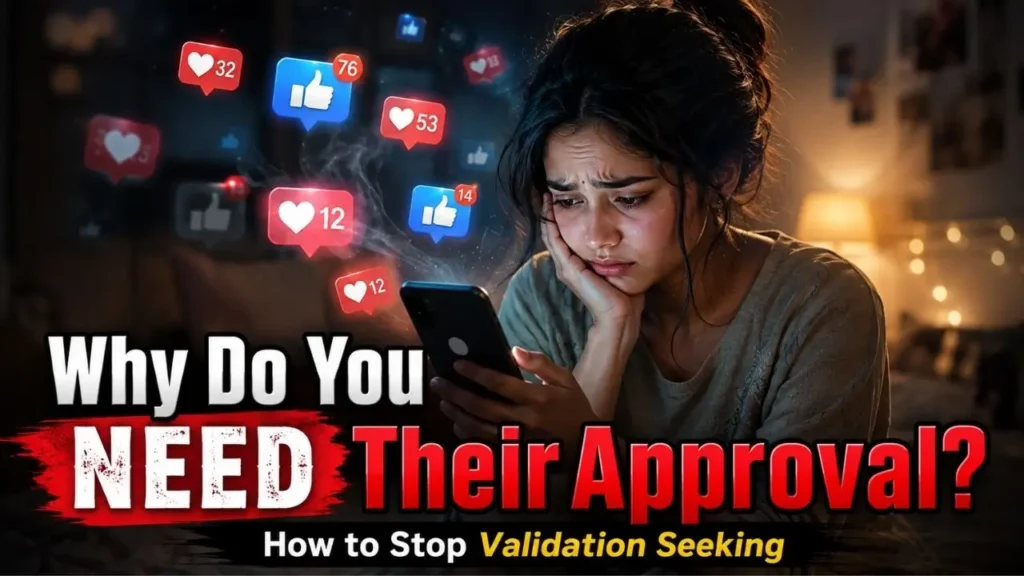
How to Stop Seeking Validation: Have you ever refreshed your social media feed just to see how many likes your post got? Or changed your opinion the moment someone disagreed with you?
Most of us have been there. We live in a world that constantly measures worth through reactions, comments, and approvals. And somewhere along the way, we started doing the same to ourselves.
Seeking validation occasionally is human. But when someone else’s opinion becomes the only thing that makes you feel good enough, that is when it quietly starts controlling your life.
This article explores why we seek external validation, what it costs us, and most importantly how to stop seeking validation and start trusting yourself again.
What is Validation Seeking?
Validation seeking means constantly relying on the approval or praise of others to feel that your feelings, decisions, or values are valid.
It happens when we only consider ourselves good if someone else tells us we are. For example, asking three people for their opinion before wearing new clothes or checking with several people before making a small decision, saying, “Is this okay?”
Wanting validation isn’t wrong in itself. Humans are social creatures. But when this need becomes so strong that we feel incomplete without the approval of others, it becomes a problem.

Read More: Body Image Issues: Learn to Accept Your Body & Love It
Why Do We Need Validation from Others?
There can be several potential reasons for this. For some people, childhood experiences play a role. If love or attention in childhood felt conditional, meaning it was only given when we were “good” or “successful” then the lesson is learned that we must constantly prove ourselves to be accepted.
Low self-esteem, the fear of rejection, the habit of comparison, and the influence of social media can also play a role. The tendency to people-please and a lack of confidence in one’s own decisions also fuel validation seeking.
The brain releases dopamine when we receive praise, making this behavior feel like an addiction. Our brain often perceives social rejection as physical pain. That’s why we keep being drawn to approval.
The important thing is that everyone’s reasons can be different. You can’t oversimplify this and pin the blame on any one thing.
How to Tell If You are Seeking Validation?
Here are some common signs. Do any of these sound familiar to you?
- Checking your phone repeatedly after posting on social media to see how many likes you got.
- Asking multiple people for their opinions even on small decisions: “Is this okay?”
- Hiding your true opinion and changing your stance to match others.
- Falling into deep self-doubt the moment you receive criticism.
- Feeling restless all day if you don’t get praise.
- Not being able to start anything because you’re thinking, “What will people think?”
- Constantly putting your own needs aside to keep others happy.
- Feeling uncomfortable spending time alone.
- Waiting for others’s reactions before celebrating your own success.
- Being so afraid of rejection that you don’t try anything new.
If many of these things happen repeatedly, it may mean you’ve become dependent on external validation.

The Difference: External Validation Vs Internal Validation?
External validation is the approval, praise, or acceptance you get from others. It comes from outside.
Internal validation means accepting your own feelings, decisions, and worth without anyone else’s approval.
Internal validation is essential for healthy self-worth because external approval isn’t always available. People change, and their opinions change. If our entire value depended on their mood, we would always feel unstable.
Internal validation gives us stability. It helps us understand that we are whole in ourselves, regardless of others’ opinions.
The Dangers of Constantly Seeking Validation
When validation seeking becomes compulsive, it can lead to emotional dependence. Overthinking increases. Pleasing people becomes a habit. Decision-making becomes difficult because every decision requires others’ opinions.
Rejection sensitivity can increase, meaning even a small negative reaction stings deeply. The biggest downside is that self-worth ends up in the hands of others. The person begins to lose their autonomy and becomes mentally exhausted.
How to Learn to Be Enough for Yourself?
- It’s not something that happens overnight. With gradual practice, this skill develops. Some practical ways:
- Accept your emotions without judgment. If you feel nervous after making a decision, tell yourself, “This feeling is coming up, and that’s okay.”
- Start to stop seeking others’ approval for every decision. Make small choices on your own like what to eat today or which movie to watch. Gradually, your confidence will grow.
- Change your self-talk. When the thought “what will people think?” pops into your head, ask yourself, “What do I think about this?”
- Acknowledge your achievements and qualities yourself. Even if no one else praises you, remind yourself of what you’ve done well.
- Challenge the “what will people think” mindset. Before reacting to fear, ask yourself whether it comes from the present moment or from an old pattern within you.
- Practice spending time alone. Start sitting with yourself without distractions.
- Maintain a healthy distance from social media validation. Take a break for a few hours or days and see how it feels without likes.
- Learn to set boundaries. Practice saying “no” when you don’t feel like it.
- Don’t take mistakes as personal failures. A mistake is a lesson to learn from, not a reflection of your worth.
- Adopt a daily self-validation practice. Every day, spend a few minutes reminding yourself that you can define your own worth.

5-Minute Self-Validation Exercise
Do this short exercise once a day:
- Sit in a quiet place and focus on your breath (30 seconds).
- Ask yourself, “What am I proud of today?” (Think for one minute and write it down).
- “What did I do good for myself today?” (One minute).
- “Without worrying about what others think of me, what strengths would still make me proud of who I am?” (One minute).
- Then remind yourself: “My value comes from who I am, not from how other people see me.”
It only takes five minutes, but doing it consistently strengthens your internal validation.
Conclusion: How to Stop Seeking Validation
Learning how to stop seeking validation is not about becoming emotionally closed off or pretending you don’t care what anyone thinks.
It’s about building something more stable inside a sense of worth that doesn’t collapse every time someone disagrees with you or scrolls past your post.
That shift doesn’t happen overnight. It happens in small, quiet moments when you make a decision without asking everyone around you, when you sit with discomfort instead of chasing approval, You begin to trust your own judgment and recognize when you’ve done your best, without needing approval from anyone else.
That’s where real freedom begins.
FAQ: How to Stop Seeking Validation
What is validation?
Validation means accepting and acknowledging your feelings, thoughts, or experiences. When this acknowledgment comes from others, it is called external validation, while accepting your own feelings and worth yourself is called internal validation.
Why do people seek validation?
Validation seeking can stem from several factors, such as low self-esteem, a fear of rejection, childhood experiences, comparison, and a habit of people-pleasing. When a person starts to tie their worth to the opinions of others, the need for approval can grow.
How do I know if I’m seeking validation?
If you repeatedly seek others’ opinions, let your mood be determined by social media likes and comments, or start doubting your own worth when faced with criticism, these could be signs of validation seeking. The causes and symptoms can vary from person to person.
How to reduce validation seeking?
Start making small decisions on your own and gradually reduce the habit of seeking approval for everything. Accept your feelings without judgment, pay attention to your self-talk, and learn to acknowledge your own achievements without praise from others.
Does being enough for yourself mean not needing others?
No. Self-validation doesn’t mean completely isolating yourself from others. You can still receive feedback and appreciation in relationships, but the healthy approach is not to depend on others’ opinions for your entire self-worth.

1 thought on “How to Stop Seeking Validation: Be Enough for Yourself”