Masaru Emoto Water Experiment: Have you ever wondered how deeply our words and emotions can affect something as simple as water? When I first read about Masaru Emoto’s experiment, I was amazed. The Japanese researcher’s experiment seems like a unique blend of science and spirituality. Today we’ll take an in-depth look at the Masaru Emoto Water Experiment and discuss all its aspects.
Masaru Emoto: A Dreamer Researcher
Masaru Emoto was born in 1943 in Yokohama, Japan. He was not a conventional scientist, but rather worked in the field of alternative medicine. In the 1990s, he began to study the effect of human emotions on water. His book “The Hidden Messages in Water” was published in 2004 and became a bestseller worldwide.
Emoto believed that water has a life force and absorbs our energy. A search for “Masaru Emoto biography” reveals that he began with techniques like MRI but later focused on water crystals.
Read More: Water Manifestation Technique: Most Powerful Way to Manifest Your Dreams
His life is an inspiration in itself. Even while battling cancer, he continued his work and passed away in 2014. His followers still say that Emoto taught us that positivity can change lives. But is this just imagination, or is there truth to it? Let’s dive deeper.
The Method of the Experiment: Simple but Profound
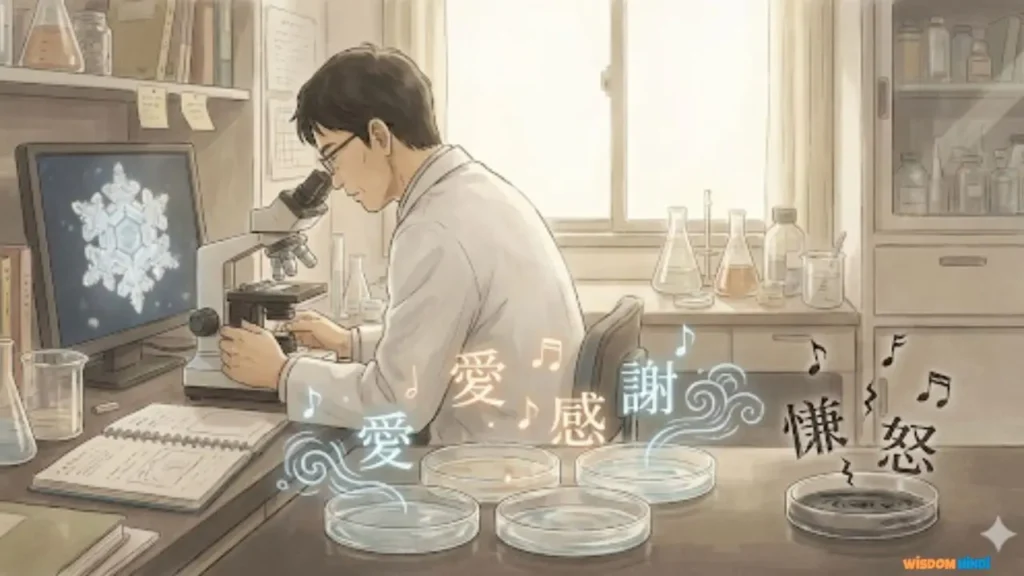
Emoto’s experiment seems extremely simple at first glance, but profound science lies behind it. They exposed small drops of water to various stimuli. For example, words like “love” or “thank you” were written on bottles. such as positive words or negative words like “hate.” Then they would freeze the water at -25 degrees Celsius and take pictures of the crystals under a microscope.
Additionally, I experimented with music, where water crystals formed beautiful, hexagonal shapes to classical music like Beethoven’s symphonies, while they became distorted and unbalanced with heavy metal music. Emoto also conducted experiments involving sending prayers from a distance. For example, focusing on water from a polluted lake produced clear, well-organized crystals. Research on Masaru Emoto’s water crystal experiments shows that he took thousands of photos, selecting only a few to include in his book.
He also conducted an experiment with rice—placing it in three jars, speaking positive words to one, negative words to another, and ignoring the third. The rice in the positive jar stayed fresh, while the rice in the negative jar rotted.
Experiment Result: The Magical Power of Thoughts
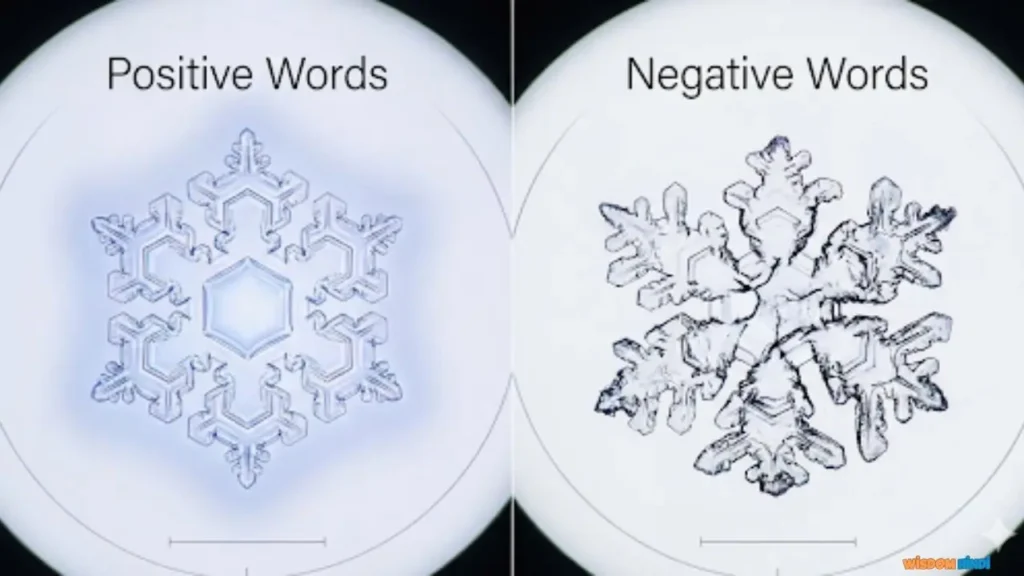
The results of this experiment were shocking. Positive emotions made the water crystals form beautiful, flower-like patterns and become lustrous, while negative ones made them look broken and ugly. Looking at the photos in Emoto’s book, it seems as if water “remembers emotions.” does. In one study, they prayed over the polluted water of the Fujiwara Dam, and the crystals showed improvement.
This idea, linked to the water memory theory, is inspired by quantum physics. Water molecules can store information, as in homeopathy. The human body is 70% water, so imagine – how might our thoughts affect ourselves? Recent research, such as a 2006 double-blind test on PubMed, tested the effect of distant intention but found mixed results.
The Scientific Significance and Spiritual Connection of This Experiment
Emoto’s experiment later became linked to the environment and health. If thoughts can change water, then positive thinking can cure diseases. People associate “positive vibrations on water” with yoga. In Indian culture, water is regarded as a deity—the purification of the Ganges, the enhancement of water’s energy through mantra chanting. Emoto’s work aligns with the Vedas, where sound (nada) influences everything.
One article states that in Hindu traditions, water is considered a medium for spiritual cleansing, and Emoto tried to prove this with photographs. In Japan, water is also sacred in the Shinto religion. On a global level, this could help combat climate change, such as keeping rivers clean with positive energy.
Ancient Cultures Knew This Long Before Emoto Did
Emoto didn’t discover something new. He may have just photographed what humanity already knew.
In ancient Egypt, priests chanted over sacred water before using it in healing rituals. They believed sound carried divine power into water.
In Japan’s Shinto tradition, water is considered a living spirit. Purification rituals using water and intention have been practiced for over a thousand years long before Emoto picked up a camera.
In Indigenous cultures across the Americas and Africa, water was never “just water.” It was spoken to, prayed over, and treated as a conscious element.
And modern science isn’t entirely silent either. Studies in psychoneuroimmunology show that positive mental states measurably affect the body’s chemistry and remember, your body is roughly 70% water.
Emoto may be controversial. But the idea that human consciousness interacts with the physical world? That thread runs through nearly every ancient civilization on earth.
Do the Water Blessing Ritual at Home: 3 Simple Steps
This is not a complicated practice. You just need 2 minutes and a glass of water.
Step 1 – Pause and Feel
Pause for a moment before picking up your glass of water in the morning. Place both hands around the glass. Close your eyes.
Step 2 – Say the Words
Mute or say softly three times: “Thank you, love, peace.” No rush, say it while feeling it.
Step 3 – Drink Consciously
As you drink the water, think that this positive energy is entering your body with every sip.
Bonus Tip: Put a sticky note on your water bottle that says “Love,” “Energy,” or “Thank you.” This was Emoto’s simplest experiment.
Try it for 7 days. You’ll notice the difference yourself, not in the water, but in yourself.

Criticisms of the Experiment on the Touchstone of Science
But just as all that glitters is not gold, Emoto’s experiment is not beyond criticism. Many scientists call it pseudoscience. It was not published in any peer-reviewed journal. A 2011 Irish Times article stated that a triple-blind study showed no effect. Critics say that Emoto showed selective photos.
On Reddit and skeptics forums, there’s a debate that water crystals naturally vary, not because of intentions. In one YouTube video, the Rice experiment was debunked, showing that random factors like bacteria had a greater effect.
The Masaru Emoto experiment is still debated today. But remember, many great discoveries initially seemed controversial.
Here’s how to incorporate it into your daily life. Now for the real question: how do you use it in everyday life? You can say “thank you” as you drink water. I’ve tried it myself. Believe me, your day will go better. Write “happiness” on your water bottle and teach it to your children. Adopt the daily water blessing in Hindi. Send positive energy to the water during meditation.
Some spa centers also adopt this practice. Health experts also say that positive thoughts improve hydration.
Conclusion: Masaru Emoto Water Experiment
Masaru Emoto’s water experiment reminds us that the power of our thoughts is infinite. Reading about the Masaru Emoto water experiment in Hindi makes you feel that science and spirituality can go hand in hand. Despite the criticisms, it inspires us to stay positive. Give it a try. Are you ready to experience this magic?
FAQ – Masaru Emoto Water Experiment
What is Masaru Emoto’s water experiment?
Masaru Emoto’s water experiment demonstrates that human emotions, words, and music affect water molecules. Positive thoughts create beautiful crystals, while negative ones create distorted ones.
Is Emoto’s experiment scientifically proven?
Not entirely. Many scientists consider it pseudoscience because there are no peer-reviewed studies. However, it is inspired by quantum physics and the water memory theory.
How to do the Emoto experiment at home?
Write positive words on the water bottle, like “Love.” Freeze it and observe the crystals. Try the rice experiment. By saying positive words, keep the rice fresh.
What is its significance in Indian culture?
In India, water is considered sacred. Mantras in the Vedas enhance the energy of water, which aligns with Emoto’s work. The power of Ganga water is an example of this.
Do positive thoughts really improve health?
Yes, studies on the placebo effect and yoga have shown that positive thinking can reduce stress. Since the body is approximately 70% water, Emoto’s theory is linked to this.
